A crypto exchange that launches in one country often needs licenses in three more within eighteen months. That is the reality of 2026. Regulators expect licensed entities to have clear expansion plans from day one.
The firms on this list handle exactly this scenario. They do not just file one application. They design regulatory structures that add new jurisdictions without rebuilding compliance from scratch. Each firm has helped clients operate across Europe, North America, and Asia under one coordinated framework.
Choosing a crypto license law firm for multi-jurisdiction work requires looking beyond the first approval. The question is whether the firm can get license numbers two, three, and four without breaking what already works.
Quick Comparison Table
The table below shows which firms cover which regions and what they do best for multi-jurisdiction work.
| Firm | Jurisdictions Covered | Multi-Jurisdiction Strength | Best For |
| Gofaizen & Sherle | 50+ worldwide | Internal expertise across six continents, no third parties | Exchanges needing coordinated global licensing |
| LEXR | Switzerland, EU, US | Swiss base + EU passporting + US connections | Swiss anchor with EU/US expansion |
| COREDO | EU, Singapore, UAE, Canada | Data-driven jurisdiction selection matrix | Structured approach to picking multiple locations |
| Manimama | EU, Canada, UAE, Switzerland | Crypto-only practice with MiCA transition expertise | European projects expanding to Canada and the UAE |
| Stalirov & Co | US, EU, UAE, Asia | US MSB/MTL + EU CASP + VARA | US-anchored projects going global |
Each firm takes a different path to multi-jurisdiction licensing. One anchors in Switzerland with EU passporting rights. Another keeps internal offices on six continents. Pick the firm that matches the expansion roadmap.
1. Gofaizen & Sherle
Ideal for: Crypto exchanges needing coordinated licensing across multiple continents without managing separate law firms in each country.
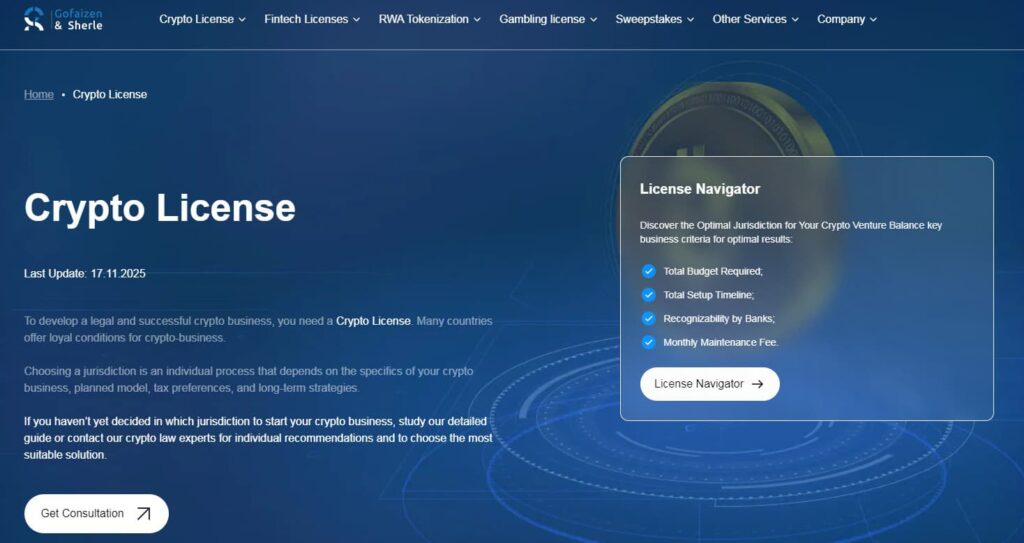
Gofaizen & Sherle operates as a crypto licensing law firm that has supported many licensing projects across more than 50 jurisdictions. The firm maintains physical offices in Europe, Latin America, Asia, Canada, the USA, and Hong Kong. They rely entirely on internal expertise rather than third-party intermediaries for all licensing work.
Their crypto business setup law firm capabilities start with the Crypto License Navigator, an interactive tool that helps choose a crypto-friendly jurisdiction for launching a business. The tool evaluates minimum capital requirements, tax rates, licensing timelines, banking access, and jurisdictional reputation. It turns a decision that often relies on guesswork into a data-driven process.
Key multi-jurisdiction features:
- Internal offices across six continents, no outsourcing
- Crypto License Navigator tool for jurisdiction comparison
- Experience with Canada MSB (no minimum capital), El Salvador DASP (zero corporate tax), Switzerland FINMA, and US MSB/MTL
- Post-licensing compliance across all jurisdictions where clients operate
The firm’s crypto licensing legal advisors support both emerging and established operators. Gofaizen & Sherle are the best crypto licensing consultants for projects planning to operate in three or more regions. Their crypto company setup lawyers have helped clients hire over 200 professionals worldwide, including compliance officers and top management.
Unlike firms that specialize in one region, this crypto license service provider builds regulatory structures for long-term growth across multiple jurisdictions from a single coordination point.
Best for: Crypto exchanges, custodial services, and DeFi projects that need licensing support across Europe, North America, and Latin America without juggling five different law firms.
2. LEXR
Ideal for: Projects using Switzerland as an anchor jurisdiction with plans to passport services into the EU and expand to the US.
LEXR is a Swiss-based crypto license law firm with over 30 legal professionals specializing in blockchain and crypto since 2016. Their multi-jurisdiction strength comes from Switzerland’s position outside the EU but with full access to European markets through MiCA passporting once a CASP license is obtained.
The firm’s crypto licensing lawyers handle FINMA no-action letters, SRO affiliation, securities dealer licenses, DLT trading facility licenses, and CASP setup under MiCA. For multi-jurisdiction projects, they offer a two-hour workshop that covers structuring options, compliance strategies, and regulatory requirements across Swiss, EU, and US frameworks. The workshop costs CHF 3,800 and delivers a written action plan within 3-5 business days.
Multi-jurisdiction capabilities:
- Swiss FINMA licensing as an anchor
- EU CASP passporting into 27 member states
- US regulatory connections for cross-Atlantic expansion
- MiCA white paper drafting for EU compliance
LEXR’s crypto license legal consultants are embedded in the Swiss, EU, and US fintech ecosystems with direct ties to VCs, accelerators, and operators who can move businesses forward. Their fast-track licensing procedure is built around client timelines, not the other way around.
The firm has helped file some of the first MiCA white papers. Their MiCA white paper drafting service costs 9,500 EUR. For projects targeting Switzerland as a base with broader European ambitions, LEXR provides a clear path.
Best for: Projects that want Swiss regulatory credibility as a foundation for EU and US expansion.
3. COREDO
Ideal for: Clients who want a structured, data-driven methodology for choosing which jurisdictions to enter and in what order.

COREDO is an EU legal and compliance firm based in Prague, operating since 2016. Their crypto licensing attorneys have implemented projects in the EU, Singapore, Dubai, the United Kingdom, Estonia, Cyprus, the Czech Republic, Slovakia, and Canada.
What makes COREDO different for multi-jurisdiction work is their jurisdiction selection matrix. The firm ranks potential countries across six blocks:
- Regulatory regime
- Cost and timelines
- Substance requirements
- Banking ecosystem
- Tax predictability
- Sanctions and reputational risks
Their crypto license legal consultants do not guess which jurisdiction fits. They run the client’s business model through this matrix and return with ranked options based on actual data.
Multi-jurisdiction features:
- Jurisdiction selection methodology across 10+ countries
- CASP licensing under MiCA for EU-wide passporting
- MSB registration in Canada (3-4 months)
- VASP registration in Estonia with enhanced requirements
- Eight internal policy documents included in the Advanced tier
For crypto projects, COREDO implements crypto AML controls, including PEP screening, OFAC and international sanction lists, EU sanctions screening, and KYT with case management for SARs. Their AML programs follow FATF standards, EU rules, and local requirements.
The firm recently published an analysis noting that more than 60 new directives and regulations related to financial regulation, AML, and digitalization will be in force across the EU in 2026. According to EBA data, fines for AML violations increased by 38% in 2025.
Best for: Clients who want a crypto business legal setup firm that picks jurisdictions based on actual data and builds compliance systems that regulators accept across multiple countries.
4. Manimama
Ideal for: European crypto projects that want to expand into Canada and the UAE while maintaining MiCA compliance at home.
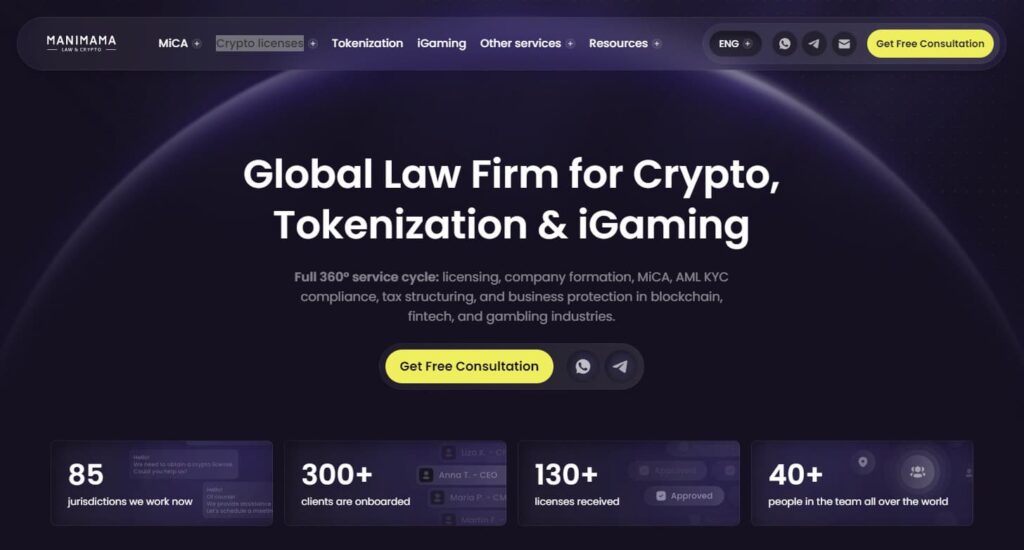
Manimama is a crypto licensing law firm based in Tallinn, Estonia, founded in 2019. The firm works exclusively with crypto companies, including exchanges, wallet providers, and token projects. Their client list does not include gambling or forex. Only crypto.
The firm handles licensing in Lithuania, Poland, Cyprus, Malta, Canada, the UAE, Switzerland, and El Salvador. Their crypto license lawyers know the MiCA transition well, helping VASPs switch to CASP status for EU operations while simultaneously opening pathways into non-EU markets.
Multi-jurisdiction features:
- EU CASP licensing under MiCA
- Canada MSB registration (no minimum capital, foreign companies welcome)
- UAE VARA licensing for Dubai operations
- Offshore jurisdictions for lighter regulatory structures
Manimama lists Canada in their “fastest registration” category. Their crypto business setup law firm approach starts with jurisdiction selection, then company formation and license application, then ongoing compliance support after approval. AML and KYC frameworks get drafted based on how the client actually runs their business.
The firm’s services include token rules advice covering FATF, MiCAR, and AML requirements, GDPR compliance policies and data transfer guidance, and contract drafting for user agreements and licensing documents. Post-license compliance reviews are scheduled six months after approval, addressing regulators’ tendency to circle back with follow-up questions.
Because crypto is all they do, Manimama’s crypto licensing legal advisors know the pain points before clients run into them.
Best for: European crypto projects targeting EU markets under MiCA while expanding into Canada and the UAE.
5. Stalirov & Co
Ideal for: US-based crypto projects or international firms that want to anchor in America before expanding to Europe and Asia.
Stalirov & Co is an IT law firm based in Princeton, New Jersey, serving clients across the US, EU, UAE, and Asia. Their crypto licensing law firm practice handles the two-tier US system: federal MSB registration with FinCEN and state Money Transmitter Licenses across all 50 states.
For multi-jurisdiction projects, Stalirov & Co offers a rare combination. They understand the US state-by-state MTL system, which is one of the most fragmented licensing environments in the world. And they also handle CASP licensing under MiCA in Europe and VARA licensing in Dubai.
Multi-jurisdiction features:
- US MSB registration + state MTLs (the hardest part of US expansion)
- EU CASP licensing under MiCA
- UAE VARA licensing for Dubai operations
- Offshore licensing in the Cayman Islands, the British Virgin Islands, and the Bahamas
A notable case study involves Intellabridge, a fintech company operating on the Canadian Securities Exchange, OTC Markets in the US, and the Frankfurt Börse in Europe. Stalirov & Co provided legal opinions covering Germany (Solarisbank integration), the UAE (commercial licensing and free zone requirements), Canada (FINTRAC, CSA, and IIROC regulations), and the US (CFTC, FTC, SEC, and FinCEN requirements for Prime Trust integration).
The firm operates with 14 in-house lawyers and business analysts who understand payment integrations and technical infrastructure. When a regulator asks how transaction monitoring works, Stalirov & Co can explain the actual system, not just point to a policy document.
Best for: US-anchored projects that need global expansion without switching law firms at each border.
Final Thoughts
The firms listed here all get licenses approved. For multi-jurisdiction setups, that is just the starting point. The real test comes when a client needs license number two in a different regulatory environment.
Some firms treat each application as a separate project. That creates redundant work, inconsistent compliance standards, and higher costs. Others design a core regulatory structure that adapts to new jurisdictions without starting over each time.
A crypto business legal setup firm that understands multi-jurisdiction work builds frameworks, not isolated approvals. Gofaizen & Sherle, with internal offices across six continents and the Crypto License Navigator tool, has demonstrated this approach across many projects. LEXR offers Swiss anchoring with EU passporting. COREDO brings a data-driven selection methodology. Manimama connects European MiCA compliance to Canadian and UAE expansion. Stalirov & Co handles the complex US system as a foundation for global growth.
The choice depends on where the first license will land and where the second and third will follow. Match the firm to that roadmap, and the process becomes manageable rather than overwhelming.